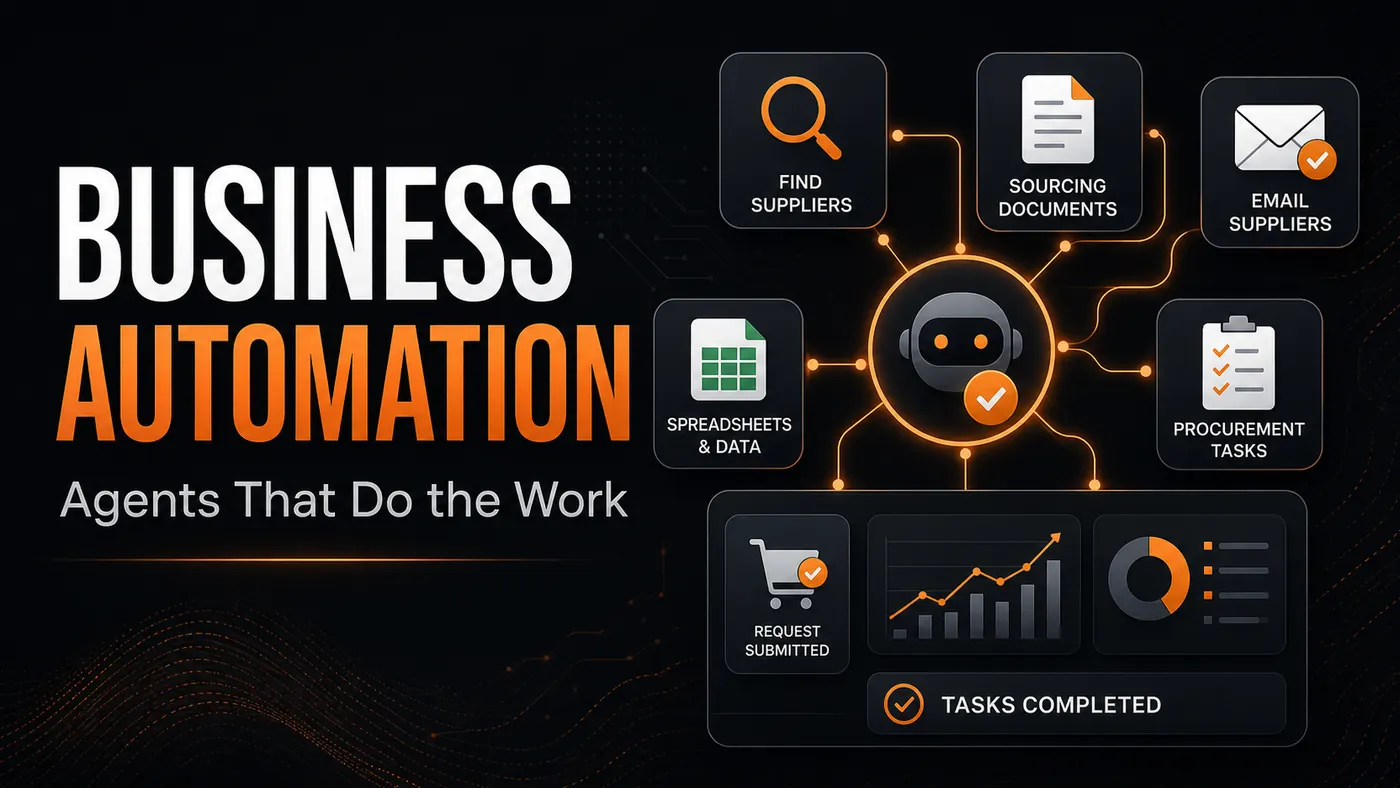
The interesting thing about tools like Alibaba's Accio Work is not that they answer questions. We already have plenty of AI that answers questions. The interesting part is the shift toward AI that completes business tasks: sourcing, comparing suppliers, preparing messages, organizing information, and moving a workflow forward.
That matters because most business work is not a single chat. It is a sequence. Find options, filter them, compare tradeoffs, ask for missing details, update a spreadsheet, draft an email, wait for a reply, and decide the next action. A useful AI agent has to understand the chain, not only one link.
Why this feels different
A normal chatbot gives you text. A business automation agent needs state. It needs to know what has already happened, what still needs to happen, and which systems should be updated. In dev terms, it is less like a text generator and more like an orchestrator sitting between data, tools, and people.
- It should remember the current workflow step.
- It should call tools only when needed.
- It should keep a clear audit trail.
- It should ask for approval before risky actions.
- It should hand off cleanly when a human needs to decide.
Where clients will feel the value
For small companies, the biggest wins are usually not futuristic. They are operational: reduce manual copy-paste, speed up research, prepare draft replies, clean incoming data, monitor changes, and turn messy inputs into structured records. These are the tasks that quietly eat a team every week.
The opportunity is to build narrower agents around real workflows. Instead of asking for an AI employee that does everything, start with a workflow that has a clear input, clear output, and repeatable decision rules. That is where automation becomes useful quickly.
The best AI automation projects start with a boring question: what task do we repeat every week that already has a clear playbook?